 Olivia Miller
Australia's dental aisle just received its most significant product launch in years. On 2 September 2026, Dyson released the CameraJet electric toothbrush in Australia at A$799 — a device that combines sonic brushing, precision liquid flossing, and an onboard dental camera into a single handheld unit. For a country where more than 30% of adults have untreated tooth decay, according to the Australian Institute of Health and Welfare, the question is not whether the technology is impressive — it clearly is. The real question is what it actually changes about the oral health decisions Australians should be making.
What the Dyson CameraJet does differently
The CameraJet is built around Dyson's proprietary Gap Optical Targeting™ system: a miniaturised camera that captures 28 live images per second while you brush. In real time, the device identifies gaps between teeth and fires a precision burst of mouthrinse into those spaces — effectively performing liquid flossing automatically, without requiring a separate water flosser or manual floss routine.
The sonic oscillation motor removes up to 69% more plaque than the market-leading electric toothbrush in Dyson's clinical trials, and the company reports users see measurable improvements in gum health within two weeks of consistent daily use. These are meaningful numbers in oral health terms: plaque is the primary driver of both tooth decay and periodontal disease, and even incremental daily reductions compound into lower long-term disease risk.
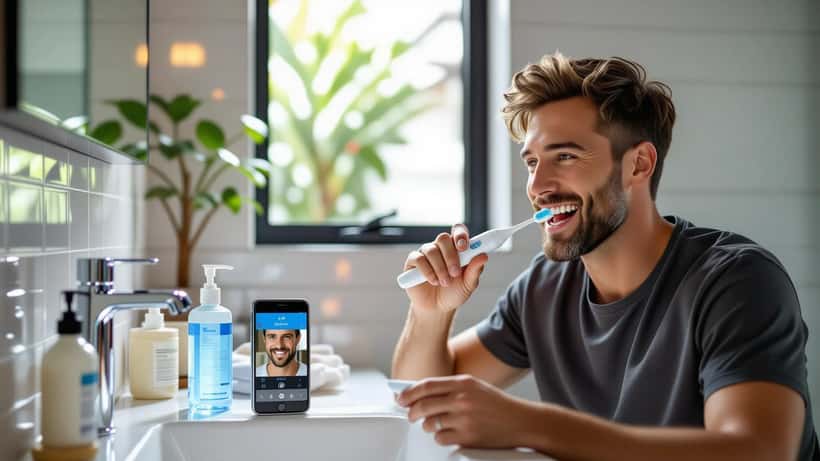
Beyond brushing, the onboard camera functions as a dental endoscope. Paired with the MyDyson app, users can view a live-stream of their own mouth — spotting staining, plaque accumulation, or early discoloration in areas a standard bathroom mirror cannot reach. It is a level of visual access previously available only during a professional dental examination.
Ongoing costs sit at approximately A$47 per two-pack of mouthrinse refills. For daily users, that translates to roughly A$24–A$47 per month beyond the initial A$799 purchase price.
The expert reaction: what oral health professionals actually think
Oral health practitioners across Australia have reacted with a nuance that pure enthusiasm or pure scepticism would miss. The device is clinically relevant in some specific ways — and irrelevant in others that matter.
The gap-jetting technology directly addresses one of the most persistent failings in home oral care: interdental cleaning compliance. Fewer than 30% of Australians floss daily, leaving the spaces between teeth — where cavities and gum disease disproportionately begin — chronically under-cleaned. A device that automates this step represents a genuine improvement for the majority of users who skip it entirely. When the 69% plaque reduction claim is maintained in real-world use rather than controlled trial conditions, it is clinically meaningful for a population where gum disease affects an estimated 23% of adults.
The CameraJet's endoscope function adds another layer of practical value. Surface staining that precedes enamel erosion, early-stage gum recession, and discoloration around existing restorations can now be spotted earlier by patients at home — prompting consultation before minor issues become structural problems. This kind of self-monitoring aligns with preventive oral health models that Australian researchers have long promoted.
Where practitioners draw a firm line, however, is on what no home device can replicate: the diagnostic scope of a clinical oral health examination. The CameraJet's camera is a user-guidance tool. It cannot produce the bitewing or periapical radiographs required to detect interproximal decay — cavities forming between teeth that are entirely invisible to any optical camera, however sophisticated. It cannot assess alveolar bone levels beneath the gumline to identify early periodontitis, screen for soft tissue pathology, evaluate bite alignment, or detect the bone changes that precede tooth mobility. Those assessments require professional training, clinical instruments, and radiographic imaging.
The CameraJet makes your daily home care significantly more effective. It does not make your dentist less necessary.
When a $799 toothbrush meets real life: James's decision
Consider James, a 38-year-old project manager in Brisbane with early-stage gingivitis — occasional gum bleeding and slight puffiness around his lower front teeth. He purchases the CameraJet on launch day and begins using it twice daily.
If James uses the CameraJet consistently, capturing the 69% plaque reduction benefit, and maintains his six-monthly professional clean at an average metropolitan Brisbane cost of A$180 per visit with his extras health cover rebate applied, his gingivitis is highly likely to resolve within 8–12 weeks. The device removes the soft plaque driving his gum inflammation; his hygienist clears the calcified tartar that has accumulated over the preceding year — hardened mineral deposits that no brushing technology, at any price, can dislodge once formed. His 12-month oral health spend: approximately A$990 (device + two visits + refills). His gum status at year's end: resolved.
If, however, James interprets the CameraJet's live-camera view of what appears to be healthy gum tissue as grounds to cancel his six-monthly appointment, a different outcome unfolds. What neither he nor the device's camera can detect: a 3mm periodontal pocket forming around his lower-right molar, visible only by clinical probing during a professional examination. By mid-2027, that pocket deepens to 5mm — the clinical threshold that typically indicates true periodontitis rather than reversible gingivitis. Treatment at that stage involves scaling and root planing across multiple quadrants, costing A$900–A$2,100, with ongoing maintenance appointments at A$200–A$350 every three to four months thereafter.
The two-year financial difference between these outcomes: A$2,500–A$4,000. The variable that determined the outcome was not the CameraJet — it was the A$180 professional check-up that James cancelled.
Signs that mean you still need to see a health professional
Even with the CameraJet used correctly every day, certain clinical signs should prompt a consultation with a registered dentist or oral health therapist rather than a self-guided camera review:
- Gum bleeding that continues beyond two to three weeks of improved daily cleaning — may indicate bacterial penetration beyond home care reach, or a systemic issue requiring investigation
- Tooth sensitivity to cold, heat, or sweet foods — signals enamel erosion, dentinal exposure, or early pulpal involvement
- Any white or red patch inside the mouth that persists longer than two weeks without a clear mechanical cause — requires professional screening for mucosal pathology
- Jaw pain, joint clicking, or restricted mouth opening — potential temporomandibular disorder requiring physical assessment
- Visible dark spots, roughness, or unexpected edges on tooth surfaces — possible active caries or fracture that a camera can identify but cannot diagnose or treat
The CameraJet's endoscope function can assist you in spotting some of these signs earlier. It cannot replace the clinical judgement, diagnostic tools, or treatment capability of a registered oral health professional.
The practical verdict for Australian consumers
For Australians who already brush with a quality sonic toothbrush and floss daily, the A$799 CameraJet offers a meaningful technological step but may not justify the premium over a A$200–A$250 alternative. For the majority of Australians — who do not maintain consistent interdental cleaning — the CameraJet's liquid jetting technology and guided camera feedback address a genuine gap in their daily routine.
What the device does not change, for either group, is the clinical value of professional oral health care. Two professional visits per year, typically A$150–A$250 each and partially or fully covered by most Australian extras health insurance policies, remain the cornerstone of preventive dentistry. The CameraJet can make those visits more productive by reducing the plaque burden a practitioner needs to address — but it cannot generate the diagnostic picture that only a trained clinician with radiographic equipment can provide.
If the Dyson CameraJet prompts more Australians to take daily oral hygiene seriously and engage more proactively with their dental care routine, it will have achieved something genuinely valuable. If it functions as a reason to avoid the dentist's chair, the clinical risks will likely outweigh every technological advantage the device offers.
The best oral health outcome costs A$799 plus A$360 per year in professional care. Not A$799 instead.
Health Disclaimer: This article is for general informational purposes only and does not constitute professional dental or medical advice. Consult a registered dentist or oral health therapist for personalised oral health assessment, diagnosis, and treatment recommendations.
