 Emily Turner
England sealed a comfortable 2-0 victory over Czechia in the UEFA Nations League on 29 September 2026, sending millions of fans into jubilation — or despair. But behind the celebrations and frustrations lies a physiological story that health professionals see regularly: the very real impact of high-stakes sport viewing on the human body and mind.
For Australian residents — expats, migrants, and football devotees who stayed up late to follow the action — the emotional intensity of tonight's match is more than passion. It can be a window into how your nervous system handles stress.
What Happens to Your Body During a High-Stakes Match
When England pressed forward and Czechia threatened on the counter, your brain was not simply watching sport. It was activating your sympathetic nervous system — the same fight-or-flight response that evolved to help humans escape predators.
Research published in the European Journal of Preventive Cardiology found that emergency department admissions for cardiac events rise by up to 25% during major football matches. Studies monitoring fan cortisol levels during high-stakes international fixtures have recorded spikes of 30–35% during tense periods of play, with levels remaining elevated for 60 to 90 minutes after the final whistle.
For most people, this is transient and harmless. The body recovers, cortisol drops, and life continues. But for a subset of fans — particularly those with pre-existing anxiety, cardiovascular conditions, or chronic stress — repeated intense emotional activation from sport can accumulate into something that warrants a closer look.
Why Australian Football Fans Carry a Unique Burden
The Australian Institute of Health and Welfare reports that mental health conditions affect approximately 1 in 5 Australians aged 16–85 in any given year. Australia also has one of the world's highest rates of sport viewership relative to population, making the intersection of sport and mental health a genuinely significant public health question.
For Australian expats tracking English football from afar, or immigrants with emotional ties to Central European nations like Czechia, sport represents more than entertainment. It is a connection to identity, community, and home. When your team loses a crucial Nations League match — or wins dramatically, as England did tonight — the psychological impact can be pronounced in either direction.
What makes football particularly intense from a mental health perspective is its unpredictability. Unlike individual sports with gradual scoring systems, football delivers abrupt emotional reversals. England's goals against Czechia came as sudden momentum shifts. Each goal — and each near-miss that preceded them — triggers a fresh wave of cortisol and adrenaline. The nervous system cannot distinguish between a real threat and a ball crossing a painted line.
The Expert Reaction: When Sports Stress Becomes Clinically Relevant
Disclaimer: This article discusses psychological responses to sport and general mental health awareness. It does not constitute medical advice. If you are experiencing significant anxiety, sleep disruption, or emotional distress, consult a registered health professional.
Health practitioners — GPs, psychologists, and sleep medicine specialists — report a recognisable cluster of presentations following major international tournament matches. These are not casual worries. They are patterned stress responses that interfere with daily functioning when left unaddressed.
The warning signs that health professionals look for include difficulty sleeping before or after a significant match, irritability and mood swings tied to sporting outcomes, physical symptoms such as elevated heart rate or gastrointestinal discomfort during viewing, and a pattern of using sport as a primary coping mechanism for life stressors. Another common indicator: significant distress or compulsive behaviour when unable to watch a match live, including sacrificing sleep, skipping commitments, or checking scores compulsively throughout the working day.
Individually, each of these signs is unremarkable. In combination, and when they recur across multiple matches over a season, they suggest that a person's emotional regulation is being partly outsourced to the outcome of 22 players on a pitch 16,000 kilometres away.
The distinction health professionals draw is between engagement and dependence. Engagement means sport enhances your life. Dependence means sport outcomes regularly determine the quality of your next 24 hours — your sleep, your mood, your relationships, your productivity.
Concrete Case: When the Sleep Debt Adds Up
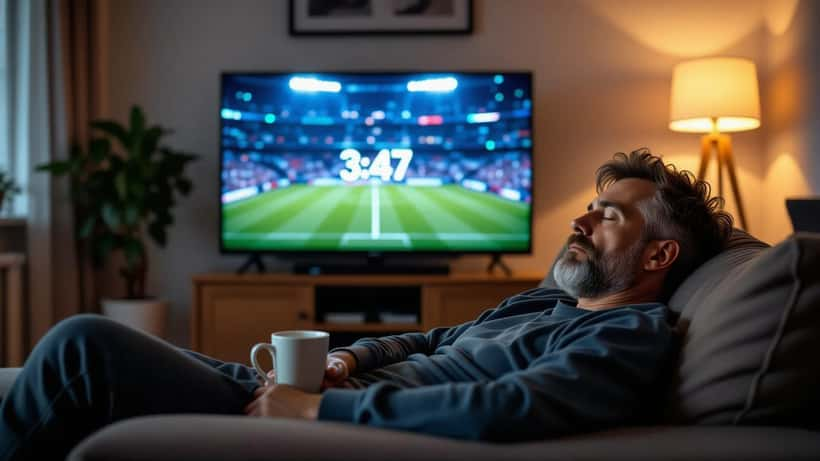
Consider a realistic scenario: an Australian resident in his late thirties — let us call him Tomáš — who emigrated from Czechia eight years ago and now works in logistics in Adelaide. Tonight, Tomáš sets his alarm for 2:45am AEST to watch Czechia face England. The match ends at approximately 4:30am. Czechia lose 0-2. Tomáš cannot fall back asleep, finally getting up at 6:30am for work.
This is a single incident. Unremarkable in isolation. But if Tomáš has followed this same pattern for 14 of Czechia's UEFA Nations League matches across the 2026-27 season — each resulting in roughly 90 minutes of lost or disrupted sleep — the cumulative sleep deficit reaches approximately 21 hours over four months.
If Tomáš also carries pre-existing work stress or a background level of anxiety, then the clinical threshold for intervention drops considerably. Sleep debt of that magnitude, compounded by emotional volatility, is associated with impaired immune response, elevated cardiovascular risk, and worsened anxiety symptoms according to research published in the journal Sleep Medicine Reviews (2023).
The number matters: 90 minutes of disrupted sleep per fixture × 14 fixtures = 21 hours of cumulative deficit. That is nearly three full nights of sleep lost — not to illness, not to a newborn, not to a work deadline — but to a football competition in Central Europe.
This is not a case for abandoning sport. Tomáš's connection to Czechia through football is genuine and valuable. But it is a case for a conversation with a GP or psychologist about sleep strategies, emotional regulation techniques, and whether the current pattern is sustainable.
Practical Strategies for Tonight and Beyond
Whether England's victory left you elated or Czechia's defeat left you flat, the following approaches are consistent with evidence-based mental health practice in Australia:
After a late-night match: Allow at least 30 minutes of low-stimulation activity before attempting sleep. Avoid replaying highlights or scrolling social media — secondary exposure to the emotional content extends your cortisol elevation. Keep your bedroom temperature cool (around 18–20°C is optimal for sleep recovery) and avoid caffeine or alcohol, both of which interfere with the REM cycles your brain needs to process emotional content.
Emotional processing: Disappointment after a significant loss is a legitimate emotional response — do not suppress or rush through it. A brief period of acknowledgement (10–15 minutes) is more effective than either suppression or extended rumination. Then redirect deliberately.
Setting personal thresholds: Before the next match, set yourself a concrete check: did last night's result affect my work or relationships the following day? Answering yes once is normal. Answering yes consistently across a season is a signal.
For Australians who recognise a more persistent pattern — anxiety that extends beyond 24 hours after a match result, sleep disruption affecting work performance, or sport increasingly intertwined with broader emotional dysregulation — a consultation with a GP or registered psychologist is the appropriate next step. Practitioners who work with stress, anxiety, and behavioural health can help you understand the architecture of your response, not just the football-shaped trigger.
Why This Matters for Australian Health in 2026
Australia's streaming revolution has fundamentally changed how Australians experience European sport. Where distance once provided a natural buffer — last night's match was a replay by morning — live streaming has eliminated that protection. Australians now experience European football in real time, at 2am, 3am, and 4am, with the same cortisol consequences as fans sitting in the stadium.
An estimated 280,000 to 350,000 Australians watch major UEFA Nations League fixtures live according to broadcast industry figures from 2025. That is a substantial population experiencing sleep disruption and emotional activation during working weeks, often without recognising the cumulative health cost.
Czechia's 0-2 defeat to England tonight will be forgotten by most within a week. But for the fraction of viewers whose nervous systems are already under sustained pressure, tonight's result is not just a score — it is another data point in a pattern worth examining.
If sport is making your life richer, that is exactly what it should do. If it is consistently costing you sleep, equanimity, or relationships, that is the moment to speak with a health professional. The consultation is shorter, and more effective, than you might expect.
format_used: Expert reaction
