 Sarah Thompson
Seven people including two serving Cleveland Police officers were killed on the A66 in South Bank, northeast England, in the early hours of Saturday 22 August 2026, after a Volkswagen Passat travelling the wrong way struck a marked police vehicle head-on. The tragedy — which unfolded after officers sighted a suspicious vehicle and initiated a pursuit — has prompted the UK's Independent Office for Police Conduct (IOPC) to open a formal investigation. Australians following this story from afar are left with a question that cuts much closer to home: when a police pursuit ends in death on our roads, what legal rights do the families of victims actually have?
What Happened on the A66
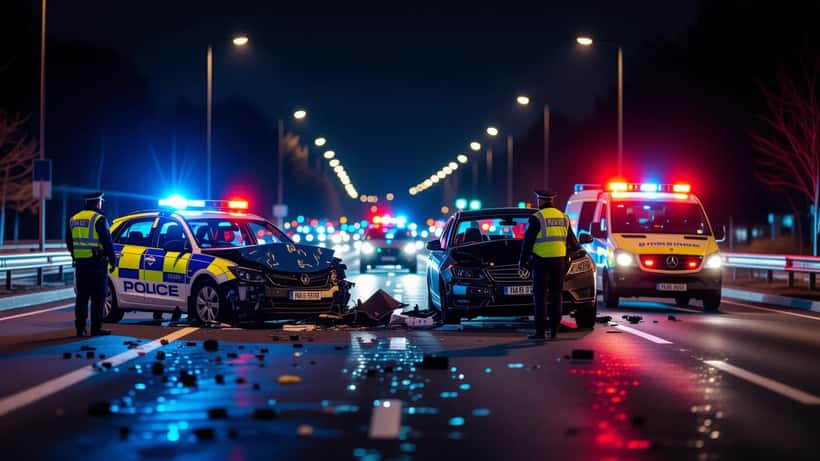
At 3:39am on Saturday 22 August 2026, a Volkswagen Passat was travelling the wrong way along the A66, a major dual carriageway near Middlesbrough in northeast England. The vehicle struck a marked Cleveland Police car head-on. All seven occupants of both vehicles died at the scene: PC Matthew Blades and PC Tom Clough — two serving officers — and five members of the public travelling in the Passat.
Critically, the police vehicle involved in the fatal collision was not directly engaged in the chase itself. Officers had earlier sighted a suspicious vehicle, and a pursuit was underway — but the car that collided was a separate unit. The IOPC, the UK's independent police watchdog equivalent to Australia's state integrity bodies, confirmed it is investigating the full sequence of events, including whether decisions made during the pursuit contributed to the conditions that caused the crash.
This is familiar territory for oversight bodies on both sides of the globe. In Australia, pursuit-related deaths have produced some of the most significant police accountability rulings in the country's legal history — and the financial implications for affected families can be substantial.
How Australian Police Pursuit Law Works
Australia has no single national pursuit policy. Each state and territory manages its own framework, but a consistent principle applies: when police initiate a pursuit, they assume a duty of care not only to their own officers but to members of the public who may be affected — including bystanders who have no connection to the fleeing vehicle whatsoever.
In New South Wales, the NSW Police Force Pursuit Policy — tightened significantly after a wave of fatal crashes in the 2000s and 2010s — requires officers to continuously reassess whether a chase is justified given the evolving risk to bystanders. If the suspected offence is relatively minor and the risk to the public is high, policy requires the pursuit to be abandoned. Failure to follow this internal policy is a cornerstone of negligence claims brought against the state.
In Queensland, the Police Powers and Responsibilities Act 2000 places proportionality obligations on officers initiating and continuing any pursuit. Victoria operates under similar guidelines overseen by the Independent Broad-based Anti-corruption Commission (IBAC). Western Australia and South Australia each have equivalent frameworks with the same underlying obligation: pursuits must be proportionate to the offence and the risk created.
Crucially, the doctrine of Crown immunity — which once blocked most claims against government bodies — has been eroded steadily through Australian courts since the 1980s. High Court decisions through the 1990s made it increasingly viable for families to bring negligence claims against state police services when a pursuit-related death resulted from unreasonable conduct. The legal test courts apply is clear: given what officers knew at the time, was the decision to initiate or continue the pursuit reasonable? If not, the state may be held liable for the consequences.
Disclaimer: This article provides general legal information only and does not constitute legal advice. Individual circumstances vary considerably. Consult a qualified lawyer for advice specific to your situation.
If It Happened in Redland Bay: A Concrete Case
Consider a scenario grounded directly in the type of incident the A66 crash represents.
Queensland Police sight a stolen Holden Colorado at 10:30pm on a Saturday night in Redland Bay and initiate a pursuit. The driver accelerates onto Boundary Road and runs a red light at an estimated 115 km/h, T-boning a family SUV in the intersection. The two parents in the SUV are killed instantly. Their 11-year-old daughter, seated in the back, survives with serious injuries.
Two different legal outcomes are possible, depending entirely on whether officers followed their own pursuit policy.
Outcome A — policy followed: Courts examine whether the pursuit was proportionate. A stolen vehicle is a serious indictable offence. It is late at night, a low-pedestrian-traffic period, in a suburban but not densely residential area. If officers made genuine contemporaneous assessments and documented them, the pursuit may be deemed reasonable. In comparable cases where Queensland Police followed their pursuit policy, courts have awarded damages ranging from $110,000 to $480,000 — primarily through the Succession Act 1981 (Qld) for the child's loss of parental dependency over the remaining years of childhood, plus funeral and estate costs.
Outcome B — policy breached: If officers knew the vehicle was linked only to a minor traffic offence rather than a serious crime, or if they continued the pursuit through a built-up area despite an opportunity to safely withdraw and reassign to aerial or traffic camera monitoring, liability rises sharply. In those circumstances, Australian courts have awarded between $650,000 and $1.3 million — incorporating loss of dependency, loss of parental care for the surviving child through to age 18, and psychological harm damages to the estate's beneficiaries.
Time limits are strict. Under the Limitation of Actions Act 1974 (Qld), a negligence claim must be filed within 3 years of the date of death. New South Wales sets the same 3-year period under the Limitation Act 1969, with extensions available in narrow circumstances where claimants were genuinely unaware of their right to sue. Missing this window closes the door permanently in most cases.
A parallel complaint process runs alongside any civil action. In Queensland, families can lodge a formal complaint about the pursuit with the Crime and Corruption Commission (CCC). In New South Wales, the Law Enforcement Conduct Commission (LECC) performs this role. Victoria uses IBAC. These bodies can compel production of dashcam and bodycam footage, radio communications logs, and pursuit policy compliance records — material that forms the evidentiary backbone of a civil claim.
What the IOPC Investigation Tells Us About Accountability
The UK's IOPC investigation into the A66 crash will examine the full decision-making chain: why the pursuit was initiated, what communications occurred between units, how the deployment of the responding vehicle was managed, and whether the pursuit continued beyond the point a reasonable commanding officer should have called it off.
Australian oversight bodies follow the same methodology. When a formal complaint is lodged after a pursuit-related death in Australia, bodies like the CCC and LECC request the pursuit log, vehicle telemetry, dashcam footage from all involved units, and communications between units and command. This process typically takes 6 to 18 months — but the findings directly influence the strength of any parallel civil claim.
The pattern across both the UK and Australian systems is consistent: accountability is not automatic. Families who do not act promptly — engaging legal representation, lodging formal complaints, and securing time-sensitive evidence — routinely forfeit avenues that were available to them.
What to Do If Your Family Is Affected
If you or a family member has been killed or seriously injured in connection with a police pursuit in Australia, the actions taken in the first weeks after the incident are critical.
In the first 72 hours: Document everything accessible at or near the scene — photographs, locations of CCTV cameras on nearby businesses and traffic infrastructure, witness contact details. Obtain the police incident number and ask whether the matter will be referred to an oversight body.
Within 28 days: Engage a solicitor with experience in police liability. Footage from petrol stations, shopping centres, and local government traffic cameras is typically overwritten within 30 days unless a legal preservation notice is issued. Missing this window can permanently eliminate the most useful evidence available.
Before filing a formal claim: Request the pursuit policy applicable in your state at the time of the incident — these are public documents available through state police websites. Compare the policy requirements against the documented facts of the chase. Gaps between what policy mandated and what officers did form the foundation of most successful negligence claims against police in Australia.
Under the Police Powers and Responsibilities Act 2000 (Qld), officers must be able to justify every decision point in a pursuit. That accountability runs directly to the families of those harmed when things go wrong.
ExpertZoom connects families across Australia with qualified lawyers specialising in police conduct, personal injury, and wrongful death claims. You can search and contact legal professionals at no cost and with no obligation to engage.
YMYL disclaimer: Legal rights and compensation amounts vary by state, circumstances, and the specific facts of each incident. The figures cited reflect published case outcomes and are provided for general guidance only. Always seek independent legal advice before making any decisions.
