 Chloe Davis
Spider-Man: Brand New Day opened in Australian cinemas on 30 July 2026 — and yes, there is a post-credits scene worth staying for. The closing tease, which activates once the full credit roll ends, points toward Peter Parker's next appearance in the MCU and has already driven a surge of searches from Australian fans asking the same question: is there a post-credit scene in Brand New Day? The short answer is yes. The more important question, especially for the large share of viewers planning to watch at home on streaming, is whether your display and audio setup will actually do it justice.
What Happens in the Brand New Day Post-Credits Scene?
The scene centres on Ned's spider-tracker app, which begins displaying Peter Parker's location as moving off-world into an "unknown location" — effectively somewhere in deep space or another dimension. The tracker then glitches with visual effects deliberately styled after those seen in Spider-Man: Into the Spider-Verse, before the screen fades out with the on-screen promise: "Spider-Man Will Return."
The scene is brief — under 90 seconds — but it carries significant weight for MCU followers. Industry analysts at Variety have noted it as a deliberate setup for Tom Holland's participation in at least one of the two upcoming Avengers films, Doomsday or Secret Wars. Whether that plays out in a standard cinematic setting or across dimensions — as the Spider-Verse glitch implies — remains deliberately ambiguous.
The question of whether to stay seated after the credits begin rolling has one clear answer: yes. There is one scene, and it appears only once the full credit roll has concluded. No mid-credits scene precedes it, but missing the final few minutes means missing the entire MCU tease.
When Will Australians Be Able to Stream Brand New Day?
For Australians who didn't catch the film in its theatrical opening window — or who want to rewatch the post-credits moment in high definition at home — the streaming picture is more complicated than most Marvel films.
Unlike the majority of Marvel Studios productions that eventually arrive on Disney+, Brand New Day is distributed by Sony Pictures. Sony's global licensing arrangement routes its theatrical releases to Netflix, not Disney+, following the theatrical window. This applies across most major international markets, and Australian rights are expected to follow the same structure.
The standard theatrical-to-streaming window for major studio releases currently sits at approximately 45 to 90 days. Based on the Australian theatrical debut of 30 July 2026, the earliest realistic Netflix Australia availability falls around mid-September 2026, with a more probable window of October to November 2026. Netflix Australia has not yet published an official release date, which typically emerges around weeks six to eight of a film's theatrical run.
For fans expecting Disney+: the Sony-Disney licensing deal covering Australian rights has not been publicly confirmed to include Brand New Day within the same 18-to-24-month Disney+ window available in the United States. Australian Disney+ subscribers should not assume the same timeline applies locally.
Why Your TV and Audio Setup Could Mean Missing the Moment
Here is where a post-credits scene creates a specific consumer electronics problem most viewers never anticipate.
By the time a post-credits scene begins — typically three to eight minutes after the narrative conclusion of a film — a combination of automatic display and audio features may have already activated, quietly degrading the experience.
Automatic Brightness Limiters (ABL) are standard on OLED televisions from LG, Sony, and Panasonic. ABL circuits reduce panel brightness when a large percentage of the screen displays bright content for extended periods — a protection mechanism for the organic compounds in OLED panels. During a credit roll, the display is mostly dark (black background, white text), which allows the panel to run at high peak brightness. When a post-credits scene suddenly switches to a full-colour, evenly-lit image — such as the brightly lit spider-tracker screen in Brand New Day — ABL engages almost immediately, dimming the picture by as much as 30 to 40 per cent within the first three seconds.
This is not a fault. It is intended behaviour. But if your OLED television is not calibrated for your actual viewing environment, you may experience a significant dimming effect precisely when the post-credits scene begins — the worst possible moment.
Audio compression features create a parallel issue. Most soundbars and AV receivers include an automatic dynamic range compression setting, marketed under names like Night Mode, Smart Volume, or DRC (Dynamic Range Control). These features compress loud passages and boost quiet ones. After several minutes of quiet end-credit music, some receivers recalibrate their baseline gain, meaning the opening audio of a post-credits scene — particularly one designed with a dramatic visual reveal — arrives at lower-than-intended volume before the system readjusts.
If Your Setup Isn't Calibrated, Here's What Happens
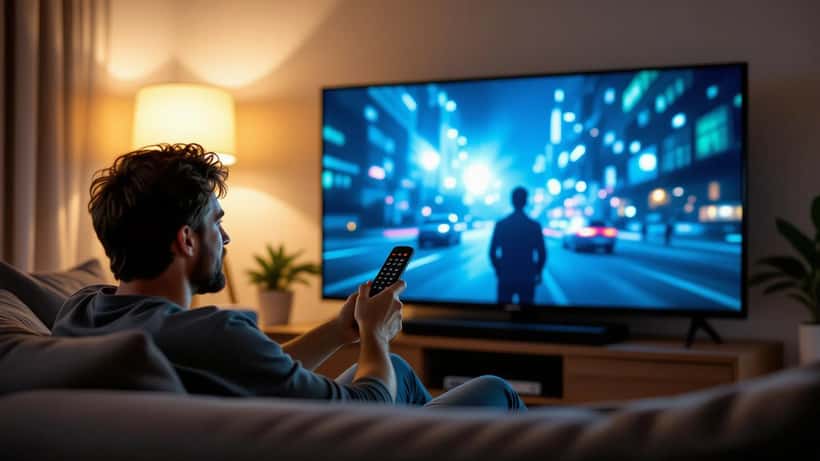
Consider a viewer who recently purchased a 65-inch OLED television — a common configuration in Australian living rooms, given that OLED panels now account for approximately 18 per cent of premium TV sales in Australia. The television was set up out of the box in Vivid or Standard mode, the factory default across most major retail chains.
In Vivid mode, ABL engages significantly earlier and more aggressively than in a calibrated Cinema or ISF mode. When that viewer sits through the six-minute credit roll of Brand New Day and the post-credits scene opens with Ned's brightly lit app screen filling the display, the ABL circuit will typically reduce luminance within two to three seconds.
At a typical 65-inch OLED set to Vivid mode at 700 nits peak brightness, that ABL reduction equates to a drop to roughly 420–490 nits — enough to make fine detail in the spider-tracker's glitch graphics significantly harder to read, particularly in a room with any ambient light. The visual cue that distinguishes a Spider-Verse-style dimensional glitch from a simple connectivity error could be missed entirely.
If your OLED is in default Vivid or Standard mode, the ABL will likely engage within 3 seconds of the post-credits scene beginning, reducing visible brightness by 30 to 40 nits and washing out fine detail. If you switch to Cinema, Movie, or a calibrated custom picture mode before watching, ABL is typically set to a gentler curve, activating only at sustained brightness levels above 800 nits — giving you the full visual fidelity the filmmakers intended.
The adjustment takes under two minutes. But the majority of Australian viewers — particularly those who purchased a television in the past two years without professional setup assistance — have never changed the picture mode from its factory default.
What a Consumer Electronics Expert Can Actually Help You With
Under Australian Consumer Law, electronics products must meet consumer guarantees covering acceptable quality and fitness for purpose, as outlined by the Australian Competition & Consumer Commission. A premium television that is never calibrated for its actual environment may technically work but will not perform to the specification you paid for.
A consumer electronics technician or consultant can audit your display configuration in a single home visit. Calibration sessions in major Australian cities — Sydney, Melbourne, Brisbane, Perth — typically range from $120 to $250 depending on the equipment complexity. The outcome of a professional calibration includes:
- Picture mode optimisation — setting Cinema or ISF modes calibrated to your actual room lighting conditions (measured in lux), ensuring ABL curves engage only when genuinely necessary
- Audio tuning — disabling DRC or Night Mode features on soundbars and AV receivers so the audio mix plays at its intended dynamic range, particularly for post-credits and dramatic end-sequence content
- HDMI port and source configuration — ensuring streaming devices (Apple TV, Chromecast with Google TV, Nvidia Shield) are connected to HDMI ports with full 4K HDR10 or Dolby Vision passthrough enabled
- Calibration documentation — a written record of all settings so you can restore them after firmware updates, which frequently reset custom picture profiles on Samsung, LG, and Sony televisions
A calibrated setup means that when Brand New Day hits Netflix Australia — wherever in the October–November 2026 window that falls — you are watching with the correct brightness, colour space, and dynamic range the filmmakers intended. That includes, specifically, post-credits scenes.
What Australian Fans Should Do Right Now
If you've already seen Brand New Day in cinemas and confirmed the post-credit scene exists, there are four immediate steps worth taking before the streaming release arrives:
Check your current TV picture mode — if you're on Vivid, Standard, or Dynamic, switch to Cinema or Movie now. Most OLED manufacturers include a direct option in the picture settings menu. It takes under two minutes and improves every film you watch from that point forward.
Disable Night Mode on your soundbar or AV receiver — look for DRC, Smart Volume, or Night Mode in your audio settings and turn it off for movie playback. The difference in dynamic range is audible from the opening scene.
Set a calendar alert for October 2026 to check Netflix Australia for the Brand New Day streaming release. Given Sony's typical release windows, mid-October is the earliest plausible date.
Consider a professional calibration session if you have recently upgraded to a 4K OLED or QLED display. The $120–$250 cost of a single session will improve the image quality of every film and series you watch for the full lifespan of your television.
For display and audio questions specific to your current setup, ExpertZoom connects Australian consumers directly with qualified consumer electronics professionals who can advise on HDMI configurations, picture mode calibration, soundbar tuning, and full home cinema setup.
The post-credits scene in Brand New Day is brief, visually specific, and dependent on display contrast to land its full impact. Don't let an automatic brightness limiter be the reason you miss the MCU's next big tease.
This article covers consumer electronics products and configuration decisions. For advice specific to your equipment, consult a qualified consumer electronics professional.
