 Isla Henderson
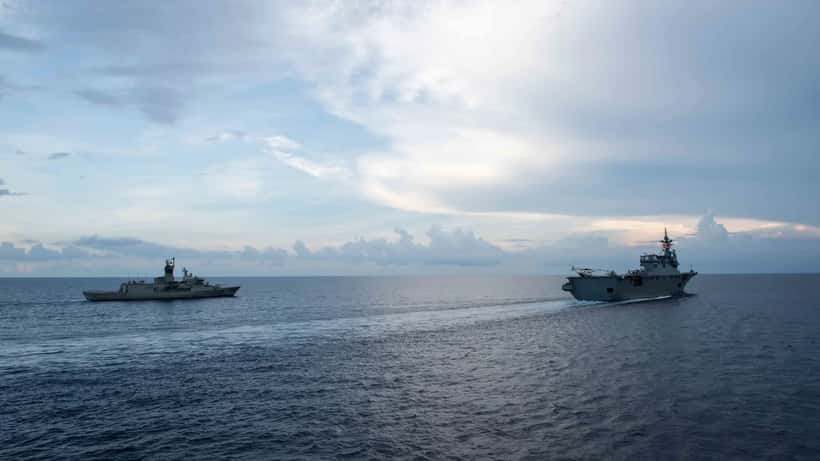
Australia has signed contracts for three Mogami-class stealth frigates from Japan in a landmark AU$10 billion deal — the largest single defence acquisition in the country's peacetime history. The signing took place on April 18, 2026, aboard the Japanese warship JS Kumano in Melbourne, with Deputy Prime Minister and Defence Minister Richard Marles and Japanese Defence Minister Shinjiro Koizumi signing what Marles called "the Mogami Memorandum."
The first three ships will be built by Mitsubishi Heavy Industries in Nagasaki, Japan, with the remaining eight of the 11-frigate programme to be constructed by Austal Limited at the Henderson Defence Precinct south of Perth, Western Australia. First delivery is expected in 2029.
The Scale of Australia's Defence Commitment
The Mogami frigate deal is the latest piece in an accelerating strategic repositioning. On April 16, just two days before the signing, Marles stood at the National Press Club and announced an additional AU$53 billion in defence spending over the next decade — bringing total planned defence investment to AU$305 billion, with a target of reaching 3 per cent of GDP by 2033.
The Mogami programme alone is budgeted at up to AU$20 billion across all 11 ships. Each vessel displaces 5,500 tonnes, stretches 133 metres, carries a 32-cell vertical launch system loaded with surface-to-air and anti-ship missiles, and operates with a crew of just 92 — roughly half the personnel needed for the ageing ANZAC-class frigates the Mogamis will replace.
"Acquiring upgraded Mogami-class frigates demonstrates our focus on investing in the capabilities we need to keep Australians safe," Marles said. "These frigates will help secure our maritime trade routes and northern approaches."
The programme sits alongside — but is separate from — the AUKUS nuclear submarine programme with the United States and United Kingdom, whose budget has risen from an initial AU$63-71 billion estimate to a revised AU$71-96 billion (a 34 per cent blowout). The frigates provide conventional surface warfare capability; the submarines provide strategic underwater strike capacity.
According to Australia's Department of Defence, the Henderson Defence Precinct in WA is receiving a separate AU$12 billion infrastructure overhaul — with actual costs expected to exceed AU$25 billion — to accommodate continuous large-vessel production.
What This Means for Western Australia and Australian Workers
The most direct impact of the Mogami deal is jobs, and most of those jobs are in Western Australia.
Government and industry forecasts project approximately 10,000 high-skilled positions at and around the Henderson precinct over the next two decades. These span naval architecture, marine engineering, combat systems integration, electronics, project management, supply chain logistics, and trade apprenticeships in welding, fitting, and precision manufacturing. Austal has already started advertising WA-based positions.
The production timeline is structured to ensure no gaps. Austal is currently delivering Landing Craft Medium vessels under a AU$1.029 billion contract awarded in December 2025, followed by Landing Craft Heavy under a AU$4 billion contract signed in February 2026. The Mogami programme then extends the production line well into the 2040s — meaning anyone entering defence manufacturing at Henderson now can expect a career arc spanning multiple major programmes.
Defence Industry Minister Pat Conroy framed the announcement explicitly in terms of sovereign industrial capability: "We are delivering these commitments at pace, supporting and creating jobs for Australians, and deepening Australia's industrial base."
Japan's Mitsubishi Heavy Industries will also transfer manufacturing expertise to Australian workers during the build of the first three vessels in Nagasaki — a deliberate knowledge-transfer arrangement before domestic production begins.
What Investors Should Watch
Austal Limited (ASX: ASB) is the direct beneficiary of the domestic build programme, and its investment case has shifted materially in 2026.
The company carries an order book of approximately AU$17.7 billion — and that figure does not yet fully incorporate the Mogami frigate programme, which would extend visible revenue by another decade-plus. Analyst consensus target price is approximately AU$6.12, compared to shares trading near AU$4.52 in early April 2026 — an implied upside of roughly 35 per cent.
The stock has been volatile. Austal disclosed a US$17.1 million accounting error in February 2026, which triggered a 23 per cent single-day drop. The shares subsequently recovered approximately 35 per cent in the March quarter on the back of the Landing Craft Heavy win and renewed investor confidence. The Mogami contract announcement adds further weight to the bull case, though governance risk from the accounting irregularity remains a factor.
Austal's major shareholder, South Korea's Hanwha Group (which holds 19.9 per cent, cleared by the Foreign Investment Review Board in late 2025), provides additional strategic credibility — Hanwha is one of the world's leading defence manufacturers and brings industrial and supply chain depth to the Henderson programme.
For Australians thinking about portfolio exposure to the defence sector more broadly, this moment marks a structural shift. Australia's defence spending as a share of GDP is on a confirmed upward trajectory from approximately 2 per cent today to 3 per cent by 2033. That trajectory creates long-duration, government-contracted revenue streams across shipbuilding, aerospace, guided weapons, and cybersecurity.
Important note: Defence stocks carry unique risks, including programme delays, cost overruns, regulatory scrutiny, and sovereign capability requirements that can override commercial considerations. Austal's accounting issue is a governance caution flag. No investment decision should be made on news reporting alone.
Career Pathways in the Defence Sector
The Mogami deal, layered on top of AUKUS submarine commitments, creates an unprecedented demand for skilled professionals across multiple disciplines.
For engineers and project managers, the Henderson precinct offers roles that are genuinely rare in Australian manufacturing — large-scale, continuous production of technically complex, world-class platforms. For graduates in electrical, mechanical, or systems engineering, defence shipbuilding now rivals mining and resources as a career destination in Western Australia.
For IT and cyber specialists, the combat systems on modern frigates require sophisticated integration of sensor networks, communications, electronic warfare systems, and autonomous platforms — all areas where civilian IT skills are increasingly transferable.
For tradespeople — welders, marine electricians, pipefitters — the 20-year production runway at Henderson represents job security uncommon in most sectors of the Australian economy.
If you're considering how to position yourself for this shift — whether as an investor reviewing your portfolio, a professional considering a career change, or a business thinking about entering the defence supply chain — speaking with a qualified financial adviser or career specialist is the right starting point. Expert Zoom connects Australians with verified financial advisers and career consultants who understand the local market.
This article contains general information about the Australia-Japan Mogami frigate deal. It does not constitute financial advice. For advice specific to your circumstances, consult a licensed financial adviser. Austal Limited (ASX: ASB) shares carry investment risks including programme delivery, governance, and market volatility.
