 Olivia Taylor
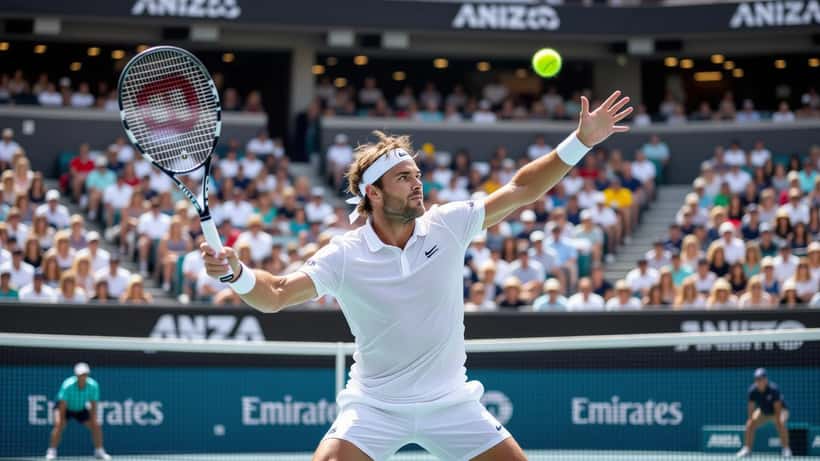
When Arthur Fery steps onto a hard court in January 2026, every ranking point he chases at the Australian Open will carry more weight than the last. The 23-year-old Briton has quietly climbed the ATP rankings through a combination of aggressive baseline tennis, improved physical conditioning, and a serve that has become noticeably more reliable in high-pressure moments. For Australian players, coaches, and parents watching from the other side of the world, Fery's trajectory offers a practical case study in how a modern professional turns potential into progress without the backing of a top-ten infrastructure.
Fery's path has never followed the conventional junior-to-pro blueprint. He played college tennis at Texas A&M and Stanford, a decision that delayed his full-time professional debut but gave him something increasingly rare on tour: time to mature physically and mentally. By the time he committed to the pro circuit, he already had years of structured training, travel discipline, and match experience against older, stronger opponents. That background is now paying dividends. In 2025 he pushed inside the top 200 for the first time, and his early 2026 schedule suggests he is targeting the Australian summer as a launchpad for a breakthrough into the top 150.
The Australian Open qualifying draw is unforgiving. Three best-of-five matches in Melbourne's heat can separate a player from a main-draw pay cheque, ranking points, and the visibility that comes with a Grand Slam appearance. Fery's game is well suited to the conditions when he is patient. His forehand is heavy enough to push opponents behind the baseline, and his backhand down the line has become a genuine weapon on hard courts. The question is whether his body can absorb the load. Players who come through the college system often arrive with sound fundamentals but without the accumulated mileage of a teenage professional. That can be an advantage, but it also means the first full seasons on tour expose weaknesses in recovery and load management that juniors have already addressed.
This is where the expert consultation model becomes relevant. A developing singles player like Fery does not need one coach; he needs a coordinated team. Strength and conditioning specialists who understand the rotational demands of the serve, physiotherapists who can spot early warning signs in the shoulder or lower back, and sports psychologists who can reframe the loneliness of qualifying draws are not luxuries at this level. They are the difference between a ranking that stalls and one that keeps climbing. Young Australian players looking at Fery's example should notice that his improvement has not come from a single technical overhaul. It has come from marginal gains across fitness, shot selection, and emotional control.
For parents and club coaches in Australia, the lesson is even more specific. The temptation in junior tennis is to specialise early, chase every local tournament, and measure progress by trophies. Fery's career suggests the opposite may be more effective: a broad athletic foundation, delayed specialisation, and a willingness to use structured environments like college tennis or academy programmes to build the adult body before asking it to perform like a professional. That approach requires patience and, often, outside guidance to navigate decisions about tournament load, equipment, and physical development.
Mental resilience is the other hidden variable. Qualifying tournaments are mentally brutal because the stakes feel disproportionate to the setting. A player can spend six months building ranking momentum and lose it in ninety minutes on a back court with no crowd and a hostile draw. Fery has spoken in interviews about the importance of routines between points and the ability to reset after a bad service game. These are trainable skills, not personality traits. Sports psychologists who work with adolescent and emerging professional players increasingly focus on pre-point breathing, attentional focus, and post-match recovery rituals rather than generic confidence building. The specificity matters.
From a technical standpoint, Fery's 2026 prospects also depend on how he manages his return position and first-serve percentage. Against bigger servers in qualifying, standing too far behind the baseline turns return games into uphill battles. Moving forward exposes him to body serves and wide angles. Finding the right return depth and neutralising power with height over the net is a tactical problem that requires video analysis and repeated practice against hard-hitting practice partners. Again, this is exactly the kind of targeted preparation that benefits from expert input rather than generic drilling.
Australian tennis has its own developmental challenges. The country produces talented juniors, but the transition to the professional tour has historically been difficult. Geography means limited access to European clay-court competition, and the domestic circuit cannot fully replicate the physicality of ATP-level tennis. Players who want to follow a Fery-style path need deliberate exposure to overseas competition, often supplemented by online coaching consultations, remote strength programmes, and physiotherapy reviews. The professionals who bridge that gap are increasingly accessible through digital consultation platforms, which removes some of the historical barriers created by distance and cost.
There is also a financial reality worth acknowledging. Fery's college background gave him an education and a fallback option, which reduces the psychological pressure that can choke young players who have bet everything on tennis by age sixteen. Australian families face a similar calculation. The cost of travel, coaching, and injury management is substantial. Access to expert advice on budgeting, sponsorship negotiations, and career planning can be as valuable as technical coaching. A player who understands their own market value and long-term options is better able to make rational decisions about which tournaments to enter and which injuries to play through.
If Fery produces a deep run at the Australian Open qualifiers or sneaks into the main draw, the narrative will focus on his ranking jump. But the underlying story is more useful: a player who combined late development, physical preparation, and mental discipline to give himself a real chance. That is the angle aspiring Australian players should copy. The hero story is not about raw talent. It is about building a support system smart enough to convert talent into results over time.
For anyone watching from the sidelines, the practical takeaway is to treat tennis development as a multidisciplinary project. Technical skill is necessary but no longer sufficient. The players who rise in 2026 and beyond will be the ones who integrate fitness science, mental skills, tactical analysis, and career management from an earlier stage. Arthur Fery is not yet a household name, but his career is becoming a textbook example of what that integration looks like in practice.
