 Olivia Miller
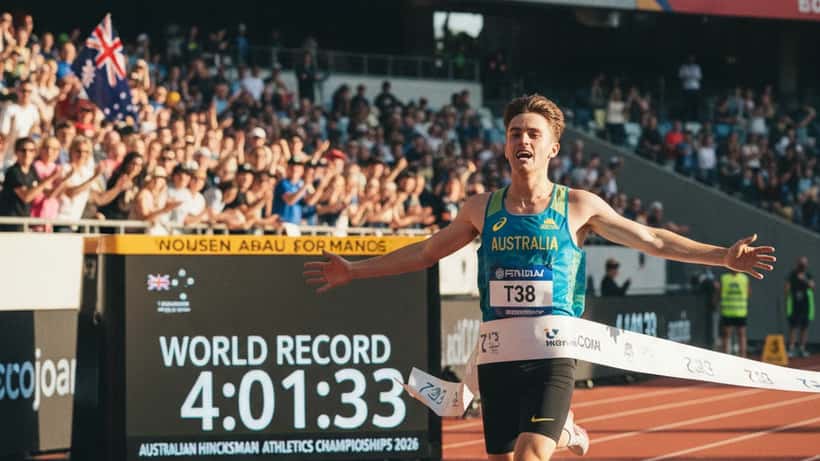
Angus Hincksman broke a world record he didn't expect to break on the first day of the 2026 Australian Athletics Championships in Sydney. The 20-year-old para-athlete — competing in the T38 classification, which covers athletes with coordination impairments such as cerebral palsy — clocked 3:46.71 in the Men's 1500m heats on 9 April 2026, bettering fellow Australian Reece Langdon's existing world record of 3:46.83.
It was a number that set up one of the most anticipated finals of the Sydney championship. And for many Australians watching, it raised a simpler question: what actually goes into preparing a para-athlete to perform at this level?
A Record That Wasn't the Goal
Hincksman, who won bronze at the 2025 World Para Athletics Championships in Tokyo, has spoken publicly about a "checklist" of career goals. A Paralympic gold medal and a World Championship title sit at the top. The world record — set casually in the heats, not the final — was a line item he reached earlier than planned.
The 2026 Australian Athletics Championships run from 9 to 12 April at Sydney Olympic Park, featuring the full spectrum of elite competition from open events to para classifications. Hincksman will contest the final after his record-setting heat.
For Australian sports fans, the moment is a reminder of the consistent excellence of Australia's para-athletic programme — a programme that produces medal-winners in large part because of the quality of specialist support available to athletes with disability.
The Role of Specialist Healthcare in Para Sport
Elite para-athletes don't work with generic sports medicine teams. The physical demands of T38 competition — where athletes may have varying degrees of muscle tightness, spasticity, balance impairment, or fine motor difficulty depending on their cerebral palsy profile — require physiotherapists, sports doctors, neurological occupational therapists, and strength and conditioning coaches who understand how these conditions interact with athletic training.
For Hincksman, who has trained through the national pathway supported by Paralympics Australia, access to this expert network has been consistent. But for the vast majority of Australians with similar diagnoses who don't reach elite sport, access to equivalent specialist support is often piecemeal and funding-dependent.
This is where the NDIS intersects with healthcare. Para-athletes at sub-elite and recreational levels are increasingly using NDIS plans to fund physiotherapy, occupational therapy, and sports participation supports — particularly as para sport has grown in profile following the Paris 2024 Paralympic Games, where Australia finished fourth on the medal table.
What Hincksman's Achievement Means for Disability Sport
Australia has a strong tradition in para-athletics, but the visibility of the discipline still lags behind the open events. Moments like Hincksman's world record — particularly one set in an opening heat, almost as a warm-up — tend to shift that. Attendance at para events during the Australian Championships has grown each year since Paris 2024, according to Athletics Australia.
The T38 classification is one of the more technically complex in para-athletics. Athletes compete without assistive devices, but their coordination impairment affects stride mechanics, rhythm, and the ability to respond to tactical moves mid-race. Elite T38 runners spend significant time working with biomechanics specialists to identify and refine the compensatory patterns that let them generate speed despite these constraints.
The crossover to everyday Australians living with cerebral palsy or other coordination impairments is direct. The same techniques used to help elite athletes optimise their gait are applied by physiotherapists and occupational therapists to help people walk more comfortably, manage fatigue, and maintain independence. Sport is the visible tip; specialist support is the infrastructure underneath.
Getting the Right Support in Australia
For Australians with neurological or physical disabilities — whether they aspire to elite sport or simply want to move better and feel stronger — finding the right specialist is the critical first step. Not all physiotherapists have training in neurological conditions. Not all GPs are familiar with the specific exercise physiology of someone living with cerebral palsy, spina bifida, or acquired brain injury.
The referral pathway in Australia typically begins with your GP, who can provide referrals to specialist physiotherapists, sports medicine doctors, or neurological occupational therapists. NDIS participants can use their plans to fund therapy supports directly without a GP referral in many cases, depending on their plan type.
Paralympics Australia's classification and athlete development information is publicly available and outlines the standards and structures that support athletes like Hincksman. For community-level participants, the Disability Sport Australia network connects people to adapted sport programmes in every state.
Whether you're watching Angus Hincksman run a world record or managing a family member's exercise plan, the message from the Sydney Athletics Championships is clear: specialist support makes the difference. Finding an expert who understands your specific condition — not just sport in general — is the single most impactful step you can take.
World records in the heats are rare. But the infrastructure that produces them — specialist knowledge, targeted therapy, expert understanding of how a condition shapes a body — is available to every Australian, not just the elite. If you or someone in your family lives with a neurological or physical disability, starting a conversation with the right specialist could open doors you didn't know existed.
