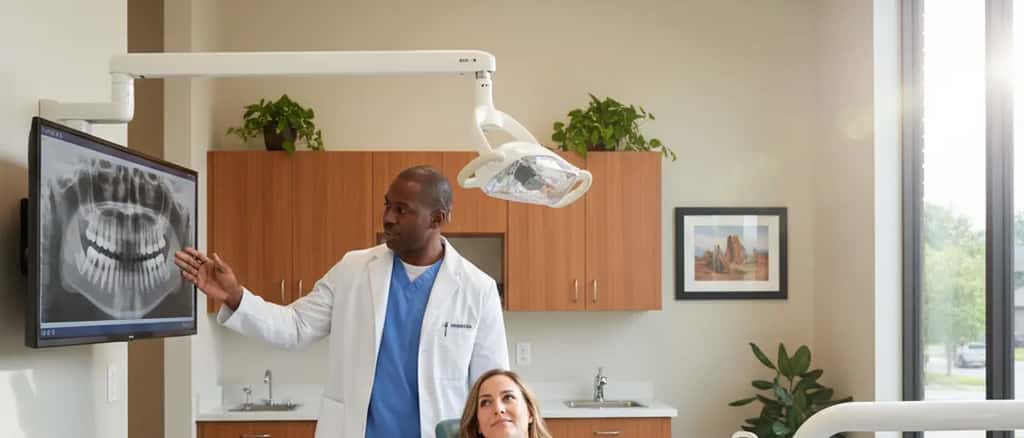
Private practice or dental chain? In-network or out-of-network? The dentist you pick shapes everything from your co-pay to your comfort in the chair. With over 200,000 practicing dentists across the United States [ADA Health Policy Institute, 2024], the real challenge is not finding a dentist near you — it is choosing the right type for your situation, your budget, and your long-term oral health.
Private Practice vs. Dental Chain: What Each One Offers
A private dental practice is owned and operated by one or two dentists who manage their own patient load, staff, and equipment. You see the same provider at every visit, which builds continuity of care. The American Dental Association reports that roughly 77% of dentists still work in private practice [ADA, 2023].
A dental chain — such as Aspen Dental, Heartland, or Pacific Dental Services — follows a corporate model. Multiple locations share branding, billing systems, and purchasing power. Appointments are often easier to book on short notice because chains staff more providers per office.
The trade-off: Private offices typically score higher on patient satisfaction surveys for personal attention, while chains often win on extended hours (evenings and Saturdays) and faster initial availability [Journal of the American Dental Association, 2023]. Neither model is inherently better. The right choice depends on whether you prioritize relationship consistency or scheduling flexibility.
In-Network vs. Out-of-Network: How Insurance Changes the Math
Dental insurance in the United States covers roughly 164 million people through employer-sponsored or marketplace plans [NADP, 2024]. Most plans use a preferred-provider network. Visiting an in-network dentist means the office has pre-negotiated fees with your insurer, which caps your out-of-pocket cost.
Going out-of-network is not prohibited — but it is expensive. You may pay the full fee upfront, then submit a claim and receive partial reimbursement based on "usual, customary, and reasonable" (UCR) rates your plan defines. The gap between what the dentist charges and what the plan reimburses falls on you.
Key point: Before booking your first visit, call your insurer or check the plan's online directory. Confirm your chosen dentist is currently in-network — provider lists change quarterly.
General Dentist vs. Specialist: When a Referral Makes Sense
A general dentist handles cleanings, fillings, extractions, crowns, and routine X-rays — roughly 80% of all dental procedures [ADA, 2024]. For most adults and children, a general dentist is the only provider needed year after year.
Specialists complete two to six years of additional training beyond dental school. The ADA recognizes twelve specialties, but four are most relevant when searching for a dentist near you:
| Specialist | What they treat | When you need one |
|---|---|---|
| Orthodontist | Misaligned teeth, bite issues | Braces, clear aligners, jaw correction |
| Periodontist | Gum disease, bone loss | Advanced gum treatment, dental implants |
| Endodontist | Tooth pulp and nerve issues | Root canals, cracked-tooth diagnosis |
| Oral surgeon | Jaw surgery, impacted teeth | Wisdom teeth removal, facial trauma |
Your general dentist will refer you when needed. A referral does not mean something is wrong — it means you are getting the most experienced hands for that specific procedure.
Key takeaway: Start with a general dentist for your routine care. Only seek a specialist directly if you already have a diagnosis requiring one — or if your general dentist recommends it.
Five Steps to Evaluate a Dentist Before Your First Visit
Finding available offices is the easy part. Deciding which one deserves your trust takes a few focused checks.
Step 1: Verify the license
Every practicing dentist must hold a state license. Search your state dental board's website — most offer a free public lookup by name. Confirm the license is active and check for any disciplinary actions.
Step 2: Read reviews with a filter
Look at Google and Healthgrades reviews, but focus on patterns, not outliers. Three complaints about rushed appointments matter more than one glowing five-star review. Pay attention to comments about wait times, billing transparency, and how staff handle emergencies.
Step 3: Ask about technology
Digital X-rays reduce radiation exposure by up to 80% compared to traditional film [FDA, 2023]. Intraoral cameras let you see what the dentist sees. Offices still using older equipment are not necessarily worse, but modern tools often mean faster, more accurate diagnoses.
Step 4: Visit the office first
Many practices offer a free or low-cost initial consultation. Use it. Observe cleanliness, note how front-desk staff communicate, and ask how long the dentist has practiced at that location. High provider turnover is a red flag.
Step 5: Confirm financial policies
Ask whether the office accepts your insurance, offers payment plans, or provides a discount for uninsured patients paying in full. About 74 million Americans lack dental coverage [CBO, 2024], so this question is far from unusual.
What to Do When You Cannot Find a Dentist Accepting New Patients
Dentist shortages affect rural counties and underserved urban neighborhoods disproportionately. The Health Resources and Services Administration (HRSA) designates over 7,300 Dental Health Professional Shortage Areas across the United States [HRSA, 2024]. If every nearby office tells you they are full, three alternatives exist.
Community health centers. Federally Qualified Health Centers (FQHCs) serve patients regardless of insurance status, charging on a sliding-fee scale based on household income. Over 1,400 FQHCs provide dental services nationally. Use the HRSA finder at findahealthcenter.hrsa.gov to locate one near you.
Dental school clinics. The roughly 70 accredited dental schools in the U.S. operate teaching clinics where supervised students perform treatments at 30–50% below market rates [ADEA, 2024]. Appointments take longer — expect two to three hours for what a private office completes in one — but care quality is closely monitored by licensed faculty.
Teledentistry for triage. Several states now allow initial consultations via video. A teledentistry visit cannot replace an in-person exam, but it can help you determine urgency, get a prescription for infection, or receive a referral to a provider who is accepting patients.
Cost Comparison: How Much Common Procedures Actually Cost
Dental prices vary sharply by region, provider type, and insurance status. The national averages below offer a baseline, but always request a written treatment estimate before agreeing to any procedure.
| Procedure | Average cost (uninsured) | Typical insurance co-pay |
|---|---|---|
| Routine cleaning | $100–$200 | $0–$50 |
| Full-mouth X-rays | $150–$300 | $25–$75 |
| Composite filling (1 surface) | $175–$300 | $50–$100 |
| Porcelain crown | $1,000–$1,500 | $300–$600 |
| Root canal (molar) | $900–$1,400 | $200–$500 |
| Wisdom tooth extraction | $300–$600 per tooth | $100–$250 |
Prices sourced from ADA Survey of Dental Fees, 2024, and FAIR Health Consumer database.
A scenario worth knowing: Maria, a 34-year-old teacher in Austin, Texas, needed a crown after cracking a molar. Her in-network dentist quoted $450 after insurance. An out-of-network specialist quoted $1,350. She saved $900 by choosing the in-network option and waiting one extra week for the appointment. The takeaway: convenience rarely justifies a threefold price difference.
Disclaimer: The information on this page is provided for informational purposes only and does not constitute medical or financial advice. Consult a licensed dentist or your insurance provider for guidance specific to your situation.
