
The most significant restructuring of Australia's aged care system in decades takes effect on 1 July 2026, when the Support at Home Programme replaces three existing programmes simultaneously. For the roughly 250,000 Australians currently receiving home-based aged care — and the hundreds of thousands more likely to need it in coming years — the shift is substantial. The Commonwealth Home Support Programme (CHSP), Home Care Packages (HCP), and Short-Term Restorative Care (STRC) are all absorbed into one unified system with a new funding structure, a new assessment framework, and revised contribution requirements. Families who understand what is changing — and when — will be far better positioned to secure the right level of support for their loved ones before and after the July transition.
Why Australia's Aged Care System Needed a Complete Rebuild
The 2021 Royal Commission into Aged Care Quality and Safety delivered 148 recommendations after finding the existing system "fails to meet the needs of older Australians." The Commission's final report, released in February 2021 after two years of hearings, documented chronic understaffing, inadequate nutrition, and unnecessary use of chemical and physical restraints [Royal Commission into Aged Care Quality and Safety, Final Report 2021]. It also identified a funding model that incentivised providers to deliver minimum rather than optimal care. Rather than patch the existing framework, the government committed to a full rebuild centred on individual rights, greater transparency, and home-based support wherever clinically appropriate.
Three structural problems made incremental reform unviable. First, waiting lists for Level 3 and Level 4 Home Care Packages stretched beyond 18 months for many Australians, leaving people assessed as needing high-level care but unable to access it [Australian Institute of Health and Welfare (AIHW), 2023]. Second, the four-package tier system created rigid funding categories that could not adapt to a person's changing needs without formal reassessment. Third, the CHSP and HCP operated under entirely separate legislation, funding streams, and administrative systems, creating genuine confusion for families trying to navigate both programmes simultaneously.
The new Aged Care Act 2024 provides the legislative foundation for the Support at Home Programme and repositions aged care services as a legal right for eligible Australians rather than a discretionary government service. This is not a terminological change — it shifts the burden of proof when care is denied or reduced, giving families stronger grounds to appeal decisions.
What the Support at Home Programme Actually Replaces
The Support at Home Programme is a full merger, not a rebrand. Three existing programmes cease to exist as separate entities on 30 June 2026:
- CHSP (Commonwealth Home Support Programme): Entry-level services for older Australians with lower or emerging care needs — domestic assistance, transport, meals, social support, and home maintenance.
- HCP (Home Care Packages): Four-tier funded packages (Levels 1–4) for people with ongoing, more complex care needs, managed through a consumer-directed model.
- STRC (Short-Term Restorative Care): Time-limited programmes designed to promote recovery, rehabilitation, or slowing functional decline following illness or hospitalisation.
Under Support at Home, these are replaced by a single registration and classification system using eight classification levels rather than the current four. The additional levels allow more precise matching of funding to assessed need — particularly for people who currently sit uncomfortably between a Level 2 and Level 3 package. Each approved participant receives an individualised budget covering defined service categories, and — for the first time — unused budget amounts in several service categories can roll over from quarter to quarter rather than being returned to the government at year's end.
A new Assistive Technology and Home Modifications (AT-HM) sub-programme sits within Support at Home, funding grab rails, shower seats, personal alarms, stair lifts, and ramp installations without requiring a separate application process. This is a meaningful practical change: families previously had to navigate multiple streams to fund what was effectively one care environment.
Key takeaway: The three programmes families know today — CHSP, HCP, and STRC — no longer exist from 1 July 2026. All new and transitioning recipients operate under a single Support at Home framework with an individualised budget.
How Eligibility and the New Unified Assessment Work
Eligibility for Support at Home follows the same baseline as the existing system: Australian citizens or permanent residents aged 65 or over (50 or over for Aboriginal and Torres Strait Islander peoples) with assessed care needs. Veterans retain separate pathways through the Department of Veterans' Affairs (DVA).
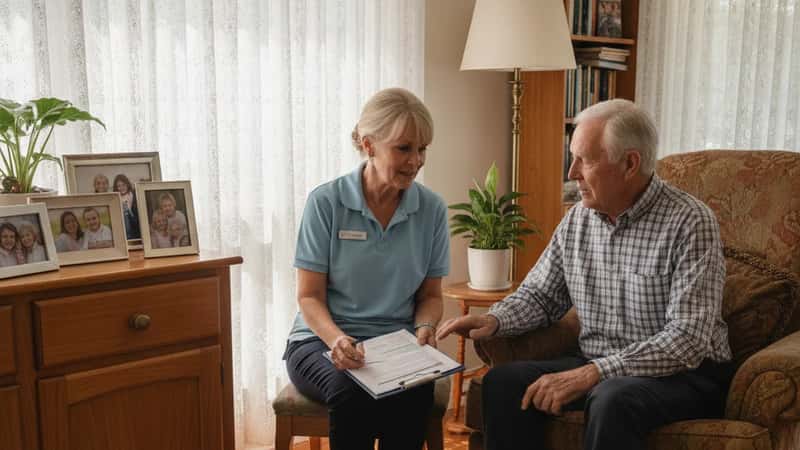
The substantive change is in the assessment process. The existing parallel systems — the Regional Assessment Service (RAS) for CHSP and the Aged Care Assessment Team (ACAT) for HCP — are being replaced by a single assessment workforce conducting a Unified Assessment. The Unified Assessment examines a person's goals, functional capacity, existing informal supports, and care needs in one integrated process rather than programme-by-programme.
Why this matters for families: a realistic scenario
Margaret is 79 and lives in a Brisbane suburb. She currently receives CHSP domestic assistance twice a week but has been told she needs to apply separately for a Home Care Package to access physiotherapy at home. Under the current system, she faces a wait of up to 12 months for a Level 2 package while managing increasing difficulty with balance and falls risk.
Under Support at Home's Unified Assessment, Margaret's full needs are assessed in a single appointment. She is classified at the equivalent of a mid-range tier that funds both domestic support and weekly allied health visits in one budget — without a separate application or additional wait period. Her assessment also includes a reablement plan: a structured, time-limited programme of physiotherapy aimed at restoring her functional independence. If successful, reablement may reduce the level of ongoing support she requires.
The Unified Assessment is also designed to reduce duplication. Families who have navigated multiple assessments for the same person — ACAT for residential, RAS for home support — will have one consolidated record through My Aged Care.
The Funding and Contribution Model: What Families Will Pay
The Support at Home Programme introduces updated contribution rules that differ meaningfully from the current HCP model. Understanding these before July 2026 avoids financial surprises during the transition.
Basic daily fee: Set at 17.5% of the single Age Pension rate. This applies to all Support at Home participants receiving ongoing services.
Income-tested contribution: Participants with income above the full Age Pension threshold pay an additional income-tested amount, calculated on a sliding scale. Unlike the current HCP system — where income-tested fees were deducted from the package budget — under Support at Home the government adjusts the participant's contribution upward rather than reducing the funded service amount. In practice, this means higher-income participants pay more out of pocket, but their funded service budget remains intact.
Lifetime contribution cap: A lifetime cap on individual contributions prevents any participant from paying indefinitely increasing amounts over a long care journey. The specific cap amount is set by the Department of Health and Aged Care and indexed annually.
AT-HM contributions: Assistive technology and home modification funding involves separate co-contribution rules, with government funding the majority of approved items for people with lower means.
Families should be aware that the exact contribution rates for their specific income situation will be calculated through My Aged Care's assessment process. Independent aged care financial advisers — who can be located through the Financial Information Service (FIS) at Services Australia — can model individual scenarios before the transition. This is particularly important for families where the person receiving care has assets from a home sale or significant superannuation.
Australia's disability support sector is undergoing parallel reform. The NDIS 2026 reforms and their impact on participant legal rights similarly shift financial responsibility to individuals with means while strengthening protections for those without.

What Current Home Care Package Recipients Need to Know About the Transition
Existing HCP recipients do not lose their entitlements on 1 July 2026, but the transition is not entirely passive. Several things require active attention.
Automatic transfer — with caveats: Existing HCP recipients transfer to the Support at Home Programme without needing to reapply. However, the mapping from the current four-level system to the new eight-level classification will result in some recipients being reviewed. Providers have been instructed to communicate individual transition arrangements in writing before the start date. If you have not received this communication from your provider by mid-June 2026, contact them directly.
Unspent package funds: Under the current HCP system, unspent funds at the end of a financial year are generally returned to the government, with limited carryover provisions. Under Support at Home, rollover rules apply per service category. Ask your provider specifically which categories allow rollover and whether any accumulated balance transfers across the transition or is forfeited.
Provider registration: All providers must be registered under the new Aged Care Quality and Safety Commission (ACQSC) framework by the start date. This is a mandatory requirement, not a voluntary opt-in. If your current provider has not communicated their Support at Home registration status to you, ask for written confirmation. Providers who miss the registration deadline cannot legally deliver Support at Home services from 1 July 2026.
CHSP recipients — a different transition: People currently receiving only CHSP services transition differently from HCP recipients. CHSP provides entry-level support, and under Support at Home these individuals will be reassessed over time rather than immediately reclassified. Check directly with your provider and with My Aged Care for your specific timing.
Five Steps Every Family Should Take Before 1 July 2026
Whether your family member is currently on a waiting list, receiving an existing package, or has not yet contacted My Aged Care, these steps are time-sensitive.
Step 1: Register on My Aged Care if you have not already done so. All access to Support at Home flows through My Aged Care (myagedcare.gov.au) or by phone on 1800 200 422. If a family member has not been registered and assessed, do this now — assessments scheduled before 1 July 2026 will be conducted under the new Unified Assessment framework where possible.
Step 2: Request your current assessment outcome in writing. Ask My Aged Care or your ACAT for a copy of the written assessment outcome, including the assessed care level. This document protects your family's position during the transition if any dispute arises about your mapping to the new eight-tier classification.
Step 3: Speak with your current provider about transition arrangements. Ask specifically: How will my package level map to the new classification? What services will and will not continue unchanged? When will I receive my first individual budget statement under the new system?
Step 4: Seek independent financial advice on contribution rates. The contribution changes under Support at Home will affect families differently based on income and assets. The Financial Information Service (FIS), operated by Services Australia, offers free financial counselling. Independent aged care advisers can also model the difference between your current out-of-pocket costs and the new contribution structure.
Step 5: Review and document your care plan with your provider. Ask for a written copy of the current care plan and confirm whether any changes are planned for the transition period. Keep records of all conversations and written communications from both providers and government agencies. Administrative complexity during a major programme transition is predictable; documentation is your best protection.
Disclaimer: The information in this article is provided for general informational purposes only and does not constitute financial, legal, or aged care advice. Individual circumstances vary significantly. Consult the Department of Health and Aged Care, My Aged Care, or a qualified aged care adviser for guidance specific to your family's situation.
