 Liam Campbell
TL;DR: Installing solar panels on an Australian home typically costs between $4,000 and $12,000 after government rebates, and most systems pay for themselves within 4 to 7 years. With Australia's exceptional solar irradiance and the Small-scale Renewable Energy Scheme (SRES), residential solar is one of the most financially sound home improvements you can make in 2026.
How Solar Panels Work on Your Home
Solar panels convert sunlight into electricity through the photovoltaic (PV) effect. When photons from sunlight strike silicon cells within the panel, they knock electrons loose, generating direct current (DC) electricity. An inverter — the brain of your solar system — then converts this DC electricity into alternating current (AC), the standard form used by your appliances.
Most Australian homes connect their solar system to the grid. During the day, your panels supply your home first; any surplus power flows back to the grid, earning you a feed-in tariff (FiT) credit on your electricity bill. At night or on overcast days, you draw power from the grid as normal. Adding a battery storage unit (such as a Tesla Powerwall or BYD HVM) lets you store excess generation for evening use, further reducing your grid dependency.
A standard 6.6 kilowatt (kW) system — the most popular size for Australian households — uses between 16 and 20 panels and occupies roughly 33 square metres of roof space.
The Real Cost of Solar Panels for Australian Homes
The upfront cost of solar panels varies by system size, panel brand, and installer. According to Solar Choice's national pricing index [2025], average installed prices in Australia are:
The key driver of affordability is the federal government's Small-scale Renewable Energy Scheme (SRES), which provides Small-scale Technology Certificates (STCs) — essentially upfront discount vouchers redeemed by your installer. The number of STCs you receive depends on your system size, geographic zone, and the scheme's deeming period (which ends in 2030).
State-based rebates add further savings. Victoria's Solar Homes Program offers eligible households up to $1,400 off a solar system and up to $2,950 off battery storage. Queensland, New South Wales, and South Australia each run their own incentive programs with varying eligibility criteria.
Types of Solar Panels: Which Is Right for Your Roof?
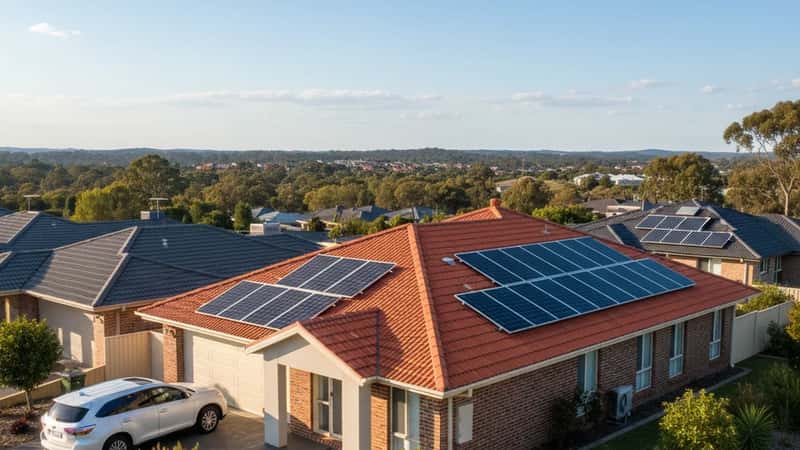
Not all solar panels perform equally in Australian conditions. The three main technologies each suit different budgets and roof configurations.
Monocrystalline panels are the most efficient residential option, converting 20–23% of sunlight into electricity. Their higher efficiency means you need fewer panels to achieve the same output — critical if your usable roof space is limited. Premium brands like SunPower, Jinko Tiger Neo, and LONGi Hi-MO 6 fall into this category. Expect to pay a 15–25% premium over polycrystalline alternatives.
Polycrystalline panels offer a cost-effective entry point with efficiencies of 15–17%. They perform slightly worse in high temperatures, which is relevant for Australian summers, but their lower upfront cost makes them attractive for larger roofs with ample space.
Thin-film panels are rarely used in residential installations due to their lower efficiency (7–13%) and larger footprint. They suit commercial flat-roof applications rather than pitched residential roofs.
What Efficiency Rating Do You Actually Need?
For most Australian homes, a 20%+ efficiency panel is the practical sweet spot. A 6.6 kW system of 20% efficient panels will generate approximately 9,000–10,500 kilowatt-hours (kWh) per year in Sydney, and up to 12,000 kWh in Darwin, where solar irradiance peaks.
The Clean Energy Council (CEC) maintains an approved products list — only panels on this list qualify for the SRES rebate. Always verify your chosen panel model is CEC-approved before signing a contract.
Is Your Roof Actually Suitable for Solar?
Before investing, a thorough roof assessment is essential. Australian solar installers conduct a site survey that examines four key factors.
Orientation and tilt: North-facing roofs at a 15–30° pitch generate the most solar energy in the Southern Hemisphere. East-west-facing systems can still be highly effective — they produce flatter, more consistent generation curves that better match household consumption patterns throughout the day.
Shading: Even partial shading from a chimney, neighbouring tree, or adjacent building can reduce output significantly. Modern systems with microinverters or DC optimisers (such as Enphase or SolarEdge) mitigate shading losses at the individual panel level.
Structural integrity: Your roof must support the additional weight of panels and mounting hardware — typically 12–15 kg per panel. Most tiled and Colorbond roofs on homes built after 1990 are suitable, but older homes may require structural reinforcement.
Age: If your roof is more than 15 years old and due for replacement within the next decade, consider re-roofing before installation. Removing and reinstalling panels later adds $1,000–$3,000 to costs.
"The biggest mistake homeowners make is not checking shading until after installation," says Marcus Webb, a CEC-accredited solar designer based in Brisbane. "A $50 shading analysis can save you 20–30% in lost generation over the system's lifetime."
Annual output varies significantly by location. A 6.6 kW system generates approximately 9,500 kWh/year in Melbourne, 10,200 kWh/year in Sydney, and 11,800 kWh/year in Brisbane [Australian PV Institute, 2025]. Use the Australian PV Institute's SunSPoT tool to estimate generation for your exact postcode and roof configuration.
The Solar Installation Process: Step by Step
Understanding the installation journey helps you plan and ask the right questions when comparing quotes.
Step 1: Get Multiple Quotes (At Least 3)
Use the Clean Energy Council's Find an Installer directory to identify CEC-accredited retailers in your area. Only CEC-accredited installers can apply for SRES rebates on your behalf. Quotes should specify panel brand and model, inverter brand, system size in kW, estimated annual generation in kWh, and total cost before and after rebates.
Step 2: System Design and Contract
Your installer designs the system layout, calculates optimal panel placement, and lodges an application with your distribution network service provider (DNSP) — the company that manages the poles and wires in your area. Grid connection approval typically takes 5–20 business days.
Step 3: Installation Day
A standard 6.6 kW residential installation takes 4–8 hours. The crew mounts the racking system on your roof, installs the panels, runs DC cabling to the inverter, and connects the system to your switchboard. You do not need to be home for the entire day, but someone should be available for the meter installation.
Step 4: Inspection and Grid Connection
A licensed electrical inspector verifies the system meets Australian Standard AS/NZS 4777.2. Your retailer then submits paperwork to your energy retailer to activate your feed-in tariff and, if applicable, export limiting controls required by your DNSP.
Scenario: When Priya Sharma, a teacher from Penrith, NSW, installed a 6.6 kW system in March 2025, her quarterly electricity bill dropped from $580 to $95. During summer months, she now receives small credits from her feed-in tariff, effectively running her home on near-zero net energy costs.
Feed-in Tariffs and Maximising Your Return
Feed-in tariffs (FiTs) — the rates electricity retailers pay you for surplus solar exported to the grid — have changed significantly in recent years. As solar penetration has grown, FiTs have fallen from the generous rates of the early 2010s to more modest levels in 2026.
Current FiT Rates by State (2026)
| State | Minimum FiT (c/kWh) | Best Available FiT (c/kWh) |
|---|---|---|
| NSW | 4.6 | 10.0 |
| VIC | 4.9 | 10.0 |
| QLD | 6.7 | 12.0 |
| SA | 5.0 | 14.6 |
| WA | 2.5 | 10.0 |
Source: state energy regulators, January 2026
À retenir: The best solar strategy in 2026 is to maximise self-consumption — shift energy-intensive appliances (dishwasher, washing machine, pool pump, EV charger) to solar hours (10 am–3 pm). Every kilowatt-hour you self-consume is worth your full retail rate (typically 28–35c/kWh), compared to a feed-in tariff of 5–14c/kWh.
Smart home energy management systems — such as the Fronius Smart Meter, Tesla Gateway, or SolarEdge Energy Hub — monitor real-time generation and consumption, automating appliance scheduling. Some modern inverters can communicate directly with smart appliances via demand-response signals.
Battery Storage: Should You Add One Now?
Home battery systems store surplus solar generation for use at night, during peak tariff windows, or during power outages. The economics have improved dramatically — the cost of residential battery storage has fallen by over 40% since 2021 [BloombergNEF, 2025] — but the case for adding a battery depends on your specific tariff structure and consumption patterns.
Battery storage makes financial sense when you are on a time-of-use tariff with peak rates above 40c/kWh (common in VIC, SA, and parts of NSW), your household uses significant power in the evening (after solar generation stops), or you want backup power for outages.
Popular Australian battery systems in 2026 include the Tesla Powerwall 3 (13.5 kWh, $12,000–$15,000 installed), BYD HVM 8.3 kWh ($9,000–$11,000 installed), and Alpha ESS Smile-G3 (10.1 kWh, ~$8,500–$10,500 installed). Most systems carry 10-year performance warranties guaranteeing 70% capacity retention.
State incentives available in 2026:
- Victoria: Up to $2,950 rebate + $8,800 interest-free loan via Solar Homes Program
- South Australia: Home Battery Scheme offers a $2,500 subsidy for eligible households
- Queensland: Battery Booster program provides $3,000 rebate for low-income households
The payback period for battery storage in isolation is typically 8–12 years, but when combined with a solar system and favourable tariff structure, the combined system payback can remain under 7 years.
FAQ: Solar Panels for Australian Homes
Are solar panels worth it in Australia?
For the vast majority of homeowners, yes. With some of the world's highest solar irradiance and strong government incentive programs, Australian homes generate excellent returns on solar investment. A 6.6 kW system installed in Sydney in 2026 will typically deliver a payback period of 4–6 years and save $1,500–$2,500 annually on electricity costs.
How long do solar panels last?
Quality panels from tier-1 manufacturers carry 25-year performance warranties guaranteeing at least 80% of original output. Physical lifespans commonly exceed 30 years. Inverters typically need replacement after 10–15 years ($1,000–$2,500).
Do solar panels work on cloudy days?
Yes, but at reduced efficiency. Panels still generate 10–25% of their rated output on overcast days. Australia's average of 2,500–3,200 sunshine hours per year means cloudy periods have minimal impact on annual totals.
Can I add solar if I rent my home?
Renters cannot install solar on properties they don't own, but some states are introducing rental solar provisions. Tenants can negotiate with landlords or access community solar schemes. The federal government's Community Batteries program is expanding shared solar access in 2026.
What maintenance do solar panels require?
Minimal. Rain cleans most dust naturally. In dry inland areas, a professional clean ($150–$300) once or twice per year improves output. Annual performance monitoring via your inverter app is recommended. Panels have no moving parts and rarely fail.
Disclaimer: The information on this page is provided for general guidance only and does not constitute financial or energy advice. Rebate eligibility, feed-in tariff rates, and government programs change frequently. Consult a Clean Energy Council-accredited installer and your energy retailer for advice specific to your property and circumstances.