 Chloe Harris
Veterinary dentistry is not a luxury — it is essential care. By age three, over 80% of dogs and 70% of cats in Australia show signs of periodontal disease, the most common health problem in companion animals [Australian Veterinary Association (AVA), 2024]. Left untreated, oral bacteria don't just cause tooth loss: they enter the bloodstream, contributing to kidney, liver, and heart disease. The good news is that dental disease is almost entirely preventable. Here is a step-by-step guide to understanding and navigating veterinary dentistry for your pet.
Step 1: Recognise the Warning Signs Early
The first step in veterinary dentistry is awareness. Many pet owners don't realise their animal is in pain because pets instinctively hide discomfort. By the time symptoms are obvious, disease is often advanced.
Common signs of dental disease in dogs and cats include persistent bad breath (halitosis), difficulty chewing or dropping food, pawing at the mouth, visible tartar — the brownish-yellow crust along the gum line — and bleeding or inflamed gums. You may also notice your pet becoming reluctant to play with toys they previously enjoyed.
In Australia, a survey by the AVA found that only 15% of pet owners brush their animal's teeth regularly, yet dental disease is the number one reason for veterinary visits in animals under 10 years old [AVA, 2023]. Early recognition means simpler treatment, lower cost, and far less discomfort for your pet.
Step 2: Schedule a Professional Dental Examination
Once you notice warning signs — or even if you don't — the next step is booking a professional dental examination with your veterinarian. Most vets in Australia recommend a dental check at every annual wellness visit, starting from one year of age.
During the examination, your vet assesses the oral cavity for plaque and tartar accumulation, gingivitis (gum inflammation), periodontal pockets (spaces between teeth and gum where bacteria thrive), fractured or loose teeth, and any abnormal growths or lesions.
A key distinction: veterinarians perform dental procedures under general anaesthesia. Anaesthesia-free dental scaling, sometimes offered by non-veterinary providers, is not endorsed by the AVA or the World Small Animal Veterinary Association (WSAVA) because it only addresses visible tartar and cannot safely assess structures below the gum line [WSAVA Dental Guidelines, 2022]. The risk of leaving subgingival disease untreated outweighs any perceived benefit of avoiding anaesthesia.
Step 3: Understand the Dental Cleaning Procedure
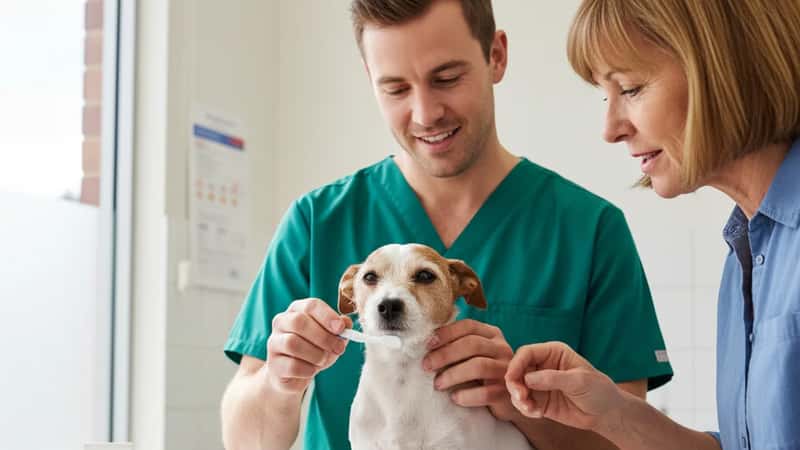
Your vet recommends a professional dental clean — called a dental prophylaxis — and you naturally want to know what to expect. Understanding the procedure reduces anxiety and helps you make an informed decision.
The process begins with a pre-anaesthetic blood panel, particularly important for older pets or those with known health conditions. This screens for issues that could affect anaesthetic safety, such as impaired kidney or liver function.
Once under general anaesthesia, the veterinary team performs:
- Supragingival scaling — removal of tartar above the gum line using ultrasonic scalers
- Subgingival scaling — cleaning below the gum line where periodontal pockets form
- Full-mouth dental radiographs (X-rays) — WSAVA guidelines recommend this for every dental procedure, as 60% of dental pathology is invisible to the naked eye [WSAVA, 2022]
- Periodontal probing — measuring pocket depth at each tooth
- Polishing — smoothing enamel surfaces to slow future plaque accumulation
- Extractions if required — fractured, mobile, or severely diseased teeth are removed
A typical dental clean for a small-to-medium dog in Australia takes 45 minutes to two hours, depending on disease severity and whether extractions are needed.
À retenir: Dental radiographs are non-negotiable for thorough veterinary dentistry. Ask your clinic if they have a dedicated dental X-ray unit — this signals genuine dental expertise.
Step 4: Navigate Anaesthesia — What to Ask Your Vet
For many Australian pet owners, anaesthesia is the biggest concern around veterinary dentistry. It is a legitimate consideration, but the risks are much lower than most people assume — and far lower than the risks of untreated dental disease.
Consider Max, a seven-year-old Labrador from Brisbane whose owner delayed dental treatment for two years due to anaesthetic concerns. When Max finally had his dental clean, the vet discovered four fractured teeth with pulp exposure, multiple grade-3 periodontal pockets, and early changes consistent with osteomyelitis (jaw bone infection). The procedure took three hours and cost $2,100 — compared to the $550 clean that had been recommended two years earlier. Max recovered fully, but the delay compounded both his suffering and the financial cost.
Modern veterinary anaesthesia is extremely safe when proper protocols are followed. Ask your vet:
- Do you perform pre-anaesthetic bloodwork before every dental procedure?
- Is a dedicated nurse monitoring anaesthesia throughout?
- Do you use modern inhalant anaesthesia (isoflurane or sevoflurane) with intubation?
- Is IV fluid support provided during the procedure?
Clinics that answer yes to all four questions meet the standards recommended by the Australian and New Zealand College of Veterinary Scientists (ANZCVS).
Step 5: Establish a Home Dental Care Routine
Professional cleaning without home care is like a dental hygienist appointment with no toothbrushing in between. The final and most important step in veterinary dentistry is the daily routine you establish at home.
Daily Tooth Brushing
Toothbrushing remains the gold standard for plaque control. Use a soft-bristled toothbrush and veterinary-specific toothpaste — never human toothpaste, which contains xylitol and fluoride that are toxic to animals. Enzymatic pet toothpastes (brands such as Virbac C.E.T.) contain enzymes that break down bacterial biofilm even without mechanical scrubbing.
Introduce brushing gradually over two to four weeks:
- Let your pet lick toothpaste from your finger
- Rub the paste along the teeth with your finger
- Introduce a finger brush
- Progress to a full toothbrush
Dental Chews, Diets, and Water Additives
For pets who resist brushing, the Veterinary Oral Health Council (VOHC) seal of acceptance identifies products clinically proven to reduce plaque or tartar. In Australia, VOHC-accepted options include certain dental diets (Royal Canin Dental, Hill's Prescription Diet t/d), enzymatic chews (Oravet), and water additives [VOHC, 2024].
These products do not replace brushing but provide meaningful supplementary benefit when used consistently.
Step 6: When to See a Veterinary Dental Specialist
General practice veterinarians manage the vast majority of dental cases. However, some conditions require the expertise of a board-certified veterinary dentist — a specialist who has completed a residency in veterinary dentistry accredited by the Australian Veterinary Boards Council (AVBC).
Referral to a specialist is appropriate for complex periodontal surgery requiring tissue grafts, endodontics (root canals) for valuable or working dogs, orthodontic abnormalities in young animals, jaw fractures or oral tumour resection, and severe or recurrent disease that does not respond to standard treatment.
In Australia, veterinary dental specialists practice primarily in capital cities. The Australian Veterinary Dental Society (AVDS) maintains a searchable directory of diplomates. Specialist consultations typically cost $350–$600 for the initial assessment, with procedures varying widely based on complexity.
À retenir: Not every practice has full dental radiography equipment or an experienced dental nurse. Before booking a routine dental clean, ask specifically whether your clinic offers full-mouth radiographs and has a nurse dedicated to anaesthetic monitoring.
Important notice: The information on this page is provided for general educational purposes only and does not constitute veterinary medical advice. Always consult a licensed veterinarian for assessment and treatment of your pet's specific dental health needs.
The Connection Between Oral Health and Systemic Disease
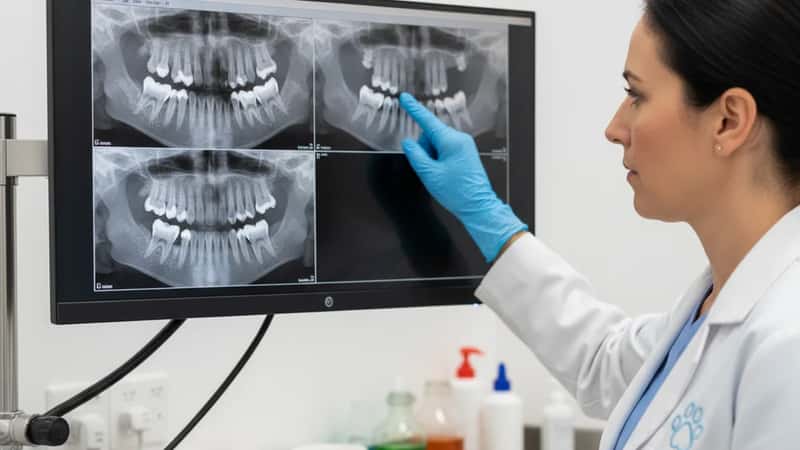
Veterinary dentistry is increasingly understood as a discipline that goes far beyond clean teeth. Research published in the Journal of Veterinary Dentistry confirms that periodontal bacteria — particularly Porphyromonas gulae and Tannerella forsythia — translocate via the bloodstream to major organs [Journal of Veterinary Dentistry, 2023]. The result is a well-documented association between chronic periodontal disease and cardiac endocarditis, chronic kidney disease (CKD), and hepatic complications in both dogs and cats.
A longitudinal study of over 20,000 dogs in the United States found that dogs with severe periodontal disease were 1.6 times more likely to develop atrial fibrillation and 1.9 times more likely to develop endocarditis than those with healthy mouths [Glickman et al., Journal of the American Veterinary Medical Association, 2023]. While large-scale Australian data is limited, the biological mechanism is identical across populations.
This systemic link transforms veterinary dentistry from an aesthetic concern into a genuine preventive medicine discipline. Treating periodontal disease effectively may extend a pet's healthy lifespan — not just preserve their teeth. This is why the AVA's position statement categorises dental care as essential veterinary care, not elective treatment.
For senior pets — generally defined as dogs over seven years and cats over ten — annual dental examinations become even more critical. Age-related immune changes make oral infections harder to resolve and more likely to spread systemically. Many Australian veterinarians now recommend six-monthly dental checks for senior patients with a history of periodontal disease.
Understanding Costs and Pet Insurance for Dental Care
One of the most common reasons Australian pet owners delay veterinary dentistry is cost. Transparency on pricing helps you plan ahead and use pet insurance effectively.
A straightforward dental clean without extractions for a small dog typically costs between $400 and $700 at a metropolitan clinic in Australia, including anaesthesia and monitoring [PetSure, 2024]. Medium and large dogs cost more due to longer procedure times. Extractions add $80–$300 per tooth, depending on complexity (simple single-rooted extractions versus surgical multi-rooted extractions). A cat dental clean averages $350–$600.
Most Australian pet insurance policies cover veterinary dentistry when the disease has been identified and diagnosed by a veterinarian — but coverage varies significantly. Key questions to ask your insurer:
- Is dental illness (periodontal disease, tooth resorption) covered, or only dental accidents (fractured teeth from trauma)?
- Is there a waiting period for dental conditions? Most policies apply a 6-month waiting period for dental illness.
- Does the policy cover pre-anaesthetic blood panels as part of the dental claim?
Pet insurance providers available in Australia with dental illness coverage include Petplan, PetSure (underwriting Woolworths Pet Insurance, RSPCA Pet Insurance, and others), and Bow Wow Meow. Always read the Product Disclosure Statement (PDS) carefully before choosing a policy.
If insurance is not in place, many veterinary clinics offer payment plans through services such as VetPay or humm — specifically designed for veterinary care. Planning ahead avoids having cost be the reason your pet suffers through preventable dental disease.